For engineering teams moving beyond basic SQL scripts, the path toward a "data platform" has become dangerously standardized. Platforms like Snowflake, BigQuery, and Databricks offer a frictionless on-ramp, but that convenience comes with a high entry fee: proprietary lock-in, opaque operational models, and a security perimeter dictated by the vendor rather than your own architecture.
This guide ignores the managed ecosystem. Instead, we are building a foundation from the ground up—an open-source data lake where you retain ownership of every component. We will construct a batch ingestion layer designed for extensibility, ensuring that subsequent additions like stream processing, governance, or advanced analytics don't force a migration to a single-vendor monolith.
We won't gloss over the grit of real-world integration. You will encounter—and resolve—the headaches that keep SREs up at night: Python version drift, malformed partition values, and misconfigured catalogs.
What You Will Build:
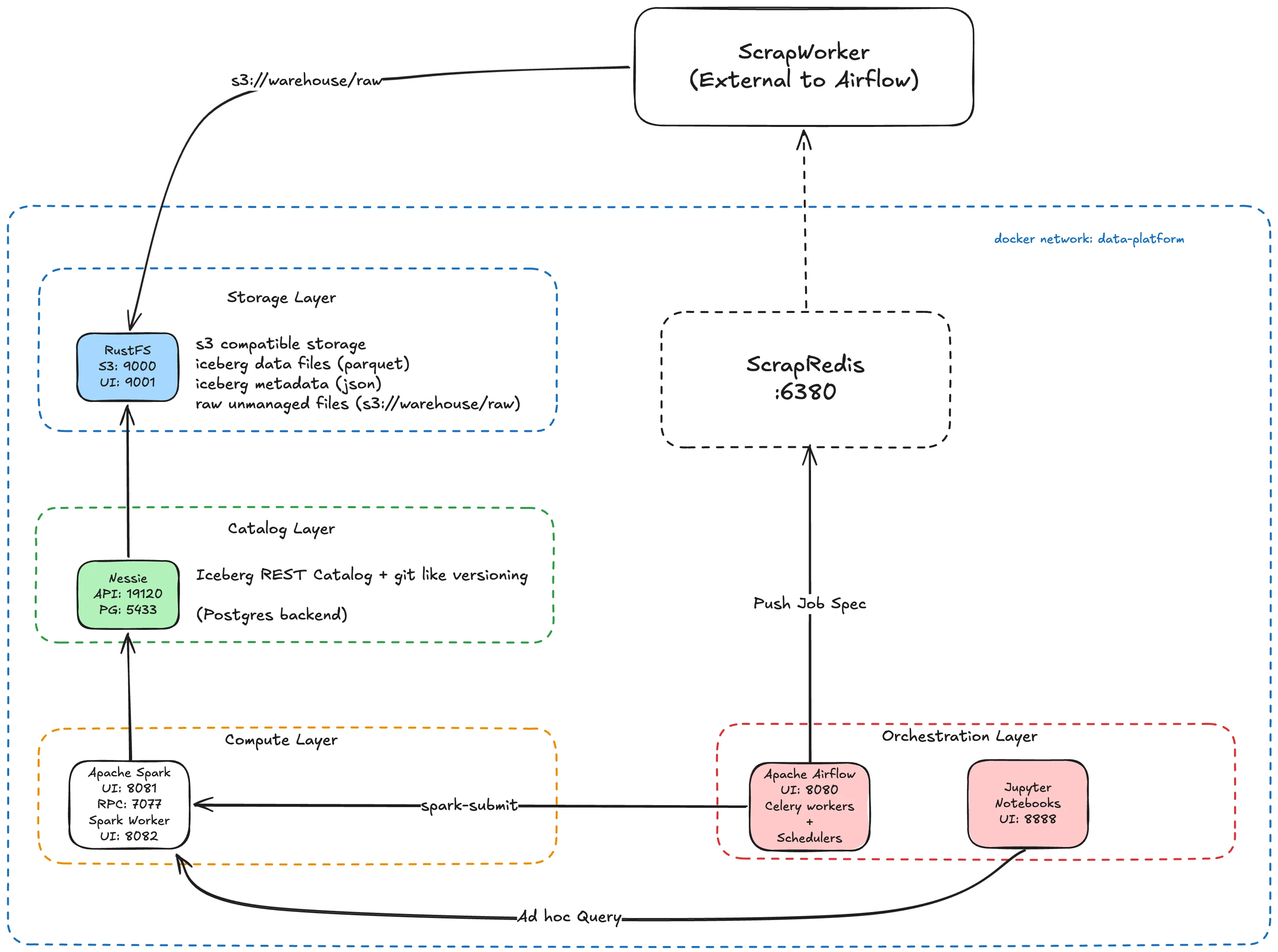
- A containerized, single-node data lake using RustFS (S3-compatible object storage), Apache Iceberg (table format), and Project Nessie (catalog).
- A robust ingestion pattern: a decoupled web scraper communicating via Redis, ensuring your ingestion lifecycle remains independent of your orchestration layer.
- An ELT foundation orchestrated by Apache Airflow, capable of executing versioned, partitioned PySpark jobs.
Note: This article focuses strictly on the 'E'—Extract. Transformation tools like dbt and analytics engines like Trino or Superset represent the next logical layer, but they are outside our current scope.
Table of Contents
The Ingestion Problem
To demonstrate a realistic ingestion architecture, we will target external financial market APIs. The primary challenge here is managing rate limits while maintaining high data reliability. Because external crawl jobs are rarely idempotent, the priority is "write-once" integrity.
By offloading the crawl process to an external worker and using Redis as a buffer, we decouple the scraper from the Airflow scheduler. This isolation is critical; if the crawler hangs due to an API rate limit, the orchestration layer remains responsive, allowing for independent retries without triggering cascading failures.
Stack
- RustFS: S3-compatible storage written in Rust.
- Project Nessie: A Git-like transactional catalog for Iceberg.
- Apache Spark: Our compute workhorse.
- Apache Airflow: Orchestration.
- Scrapredis/Scrapworker: Custom ingestion logic.
This implementation was validated on a standard 4-core/16GB RAM Linux VM (Debian Bullseye). You will need Docker Compose v2 installed to replicate this environment.
Architectural Resilience and Future Evolution
This implementation proves that a coherent data stack—leveraging Iceberg for storage, Nessie for versioned cataloging, and Airflow for orchestration—is achievable with relatively lean infrastructure. However, the operational reality of this stack requires a disciplined approach to configuration and failure modes.
Critical Operational Lessons
The primary friction point in this architecture is the synchronization between components. The requirement to maintain parity between the Spark worker and Airflow driver’s Python environments (version 3.12) is a frequent source of runtime failure. Furthermore, relying on the V2 DataFrameWriter API is mandatory for correctness; using legacy V1 writes will inevitably lead to silent metadata corruption where partition values vanish into NULL states—a difficult problem to rectify after the fact.
Isolation is equally vital. By decoupling the Scrapworker from the signal-publishing task, we ensure that storage writes to RustFS and catalog commits to Nessie don’t share a single point of failure. This design choice transforms what would otherwise be a brittle, non-idempotent process into a robust, retryable pipeline.
Strategic Evolution
As you move beyond this foundational ingestion layer, the focus should shift toward hardening and expansion:
- Operational Maturity: Shift from basic ingestion to proactive management. Implement schema validation at the configuration level and introduce SLA monitoring built directly atop the signal tables to detect drift or pipeline latency before it impacts stakeholders.
- Semantic Refinement: The current “raw-first” approach is the correct instinct. Treat the ingested data as an immutable landing zone. Use the existing Spark or dbt capabilities to transform this raw data into curated, type-safe Iceberg tables, effectively operationalizing the ELT pattern.
- Horizontal Scaling: The architecture is fundamentally agnostic to the data source. Whether you are consuming CDC streams from production databases or event-driven payloads from Kafka, the Nessie-Iceberg substrate provides a stable destination. By decoupling the ingestion method from the cataloging logic, you avoid the common trap of tight-coupling source-specific quirks to your storage layer.
The current stack is a functional prototype that treats governance as a first-class citizen rather than an afterthought. By maintaining clear separation between raw ingestion, catalog signaling, and downstream transformation, you have built a system capable of growing in complexity—through added access controls, lineage tracking, or multi-engine query support—without requiring a fundamental re-architecture.