The Industrialization of Cloud Sabotage: TeamPCP’s Shift to Kinetic Impact
The threat group identified as TeamPCP has crossed a threshold from opportunistic credential harvesting into active, localized sabotage. Over this past weekend, the group deployed a wiper payload targeting systems configured for the Iranian timezone or Farsi locale. This escalation represents a concerning pivot for a group that had, until recently, focused primarily on the industrial-scale exploitation of misconfigured cloud infrastructure.
Since late 2025, TeamPCP has distinguished itself not through zero-day research or bespoke malware, but through the aggressive automation of known vulnerabilities. Their methodology targets the control plane of cloud-native environments—specifically Docker APIs, Kubernetes clusters, and Redis instances. Data from security firm Flare confirms this focus, noting that 97% of the group’s compromises occur on AWS and Azure. By industrializing the exploitation of established attack surfaces, TeamPCP has successfully constructed a self-propagating ecosystem that treats exposed infrastructure as a commodity.
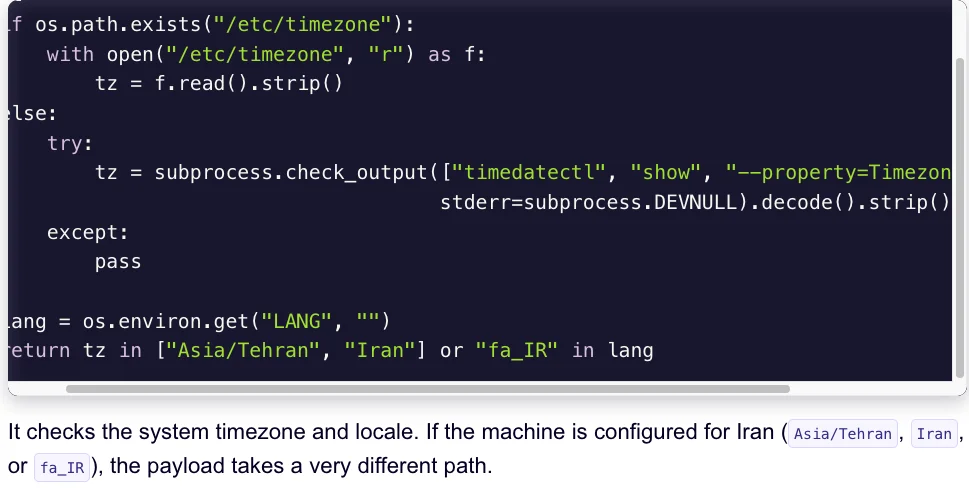
A snippet of the malicious CanisterWorm that seeks out and destroys data on systems that match Iran’s timezone or have Farsi as the default language. Image: Aikido.dev.
The group’s recent focus has centered on supply chain interdiction, specifically leveraging GitHub Actions to distribute malicious payloads. On March 19, TeamPCP compromised Aqua Security’s Trivy vulnerability scanner. The breach was significant, allowing the attackers to siphon SSH keys, Kubernetes tokens, and cryptocurrency wallet data from unsuspecting users. As noted by security researchers at Wiz, this was not an isolated incident; by March 23, the group had similarly compromised the KICS vulnerability scanner from Checkmarx. This recurring pattern suggests that TeamPCP possesses a persistent level of access to the software development supply chain, likely maintained through credentials harvested during earlier, less visible intrusions.
The infrastructure underlying these attacks, dubbed “CanisterWorm” by researchers at Aikido, highlights the group’s adoption of resilient, decentralized hosting. By utilizing Internet Computer Protocol (ICP) canisters—tamperproof, blockchain-based smart contracts—TeamPCP ensures their command-and-control infrastructure remains difficult to dismantle. So long as the group continues to fund these canisters via virtual currency, the malicious payloads remain reachable, effectively decoupling their operational stability from traditional, centralized takedown efforts.
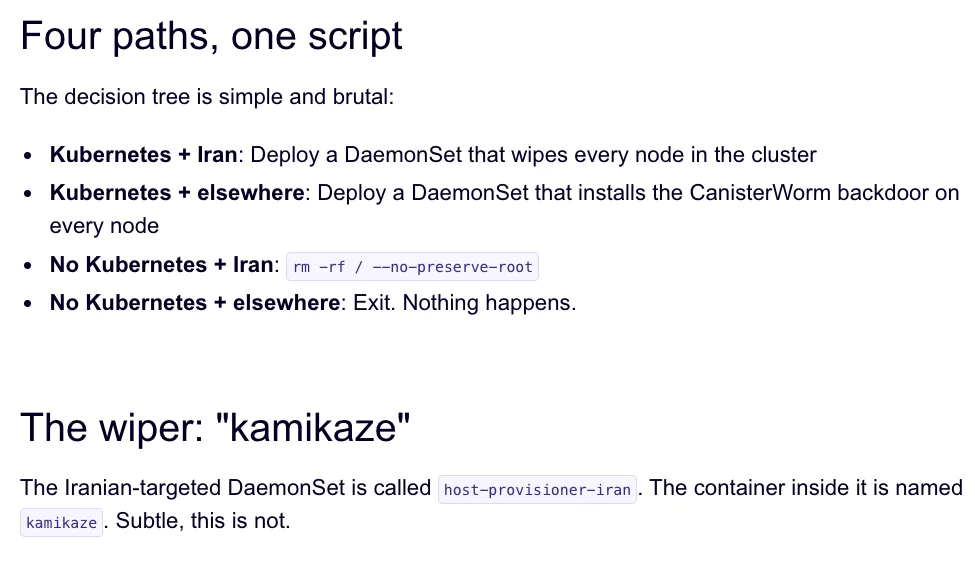
Image: Aikido.dev.
The introduction of a wiper component specifically attuned to Iranian localization marks a shift toward geopolitical signaling—or, at the very least, a chaotic attempt to garner attention. According to Charlie Eriksen of Aikido, the payload is designed to identify local machines or nodes within a Kubernetes cluster that match specific regional settings and subsequently execute a wipe command. While it remains unclear whether these wipers successfully resulted in widespread data loss, the agility of the attackers—who have been observed cycling the payload’s functionality and, at times, pointing victims to troll content—suggests a high degree of experimental volatility.
This surge in supply chain compromises highlights a growing structural weakness in modern CI/CD pipelines. As noted by Catalin Cimpanu in Risky Business, the frequency of such attacks is rising as threat actors realize the efficiency of poisoning widely used developer tools. The challenge for platforms like GitHub is immense: detecting malicious modifications within a ecosystem built on rapid forking, cloning, and versioning is a task that existing automated scanning often misses until the damage is already distributed downstream.
TeamPCP’s actions indicate a transition from passive criminal harvesting to active, disruptive operations. Their strategy of using compromised GitHub Actions to spam accounts and potentially elevate the search rankings of their own malicious packages demonstrates a sophisticated understanding of platform dynamics. Whether this is an attempt to inject themselves into a broader geopolitical narrative or simply the antics of an operator with "chaotic evil" tendencies, the outcome for organizations relying on these scanning tools is the same: the necessity of treating any third-party CI/CD integration as a potential point of ingress.
For those managing cloud-native infrastructure, the takeaway is clear. The vulnerability no longer rests solely within the application code or the container images themselves, but within the automated pipelines that define the build environment. Relying on standard vulnerability scanners is insufficient if those scanners themselves become the delivery mechanism for malicious code. Monitoring outbound traffic from build environments, restricting the scope of GitHub Action permissions, and implementing strict credential rotation after any detected pipeline anomaly are no longer optional security measures—they are a prerequisite for maintaining operational integrity in an environment where even trusted security tools can be subverted at scale.