For the modern researcher, publication speed is often at odds with the demands of career progression. While preprints have successfully chipped away at the initial hurdle of disseminating findings, the formal publication process remains the definitive metric for professional evaluation. In an environment where short-term contracts are the norm, the persistent "lag time"—the interval between submission and final appearance in a journal—remains a source of structural friction.
Inspired by recent analyses of genetics publication timelines, I revisited the data for the cell biology sector. The objective was straightforward: quantify these delays using the PubMedLagR R package, which leverages the {rentrez} library to scrape records directly from PubMed. By filtering strictly for "journal article"[pt], I aimed to strip away the noise of reviews and commentaries to focus on core research outputs.
Data Integrity and Limitations
Analysts should approach these findings with a healthy dose of skepticism. The quality of this research is entirely tethered to the metadata provided by journals to PubMed, which is often inconsistent. Anomalies—such as submission dates appearing decades before a journal’s inception—are common. Furthermore, the practice of "restarting the clock" via rejection-and-resubmission cycles can artificially compress reported timelines, masking the true operational efficiency of editorial boards.
Execution
To capture current trends, I queried a selection of high-impact and field-relevant journals ranging from 2006 to 2026:
library(PubMedLagR)
jrnl_list <- c("J Cell Sci", "Mol Biol Cell", "J Cell Biol", "Nat Cell Biol",
"EMBO J", "Biochem J", "Dev Cell", "FASEB J", "J Biol Chem",
"Cells", "Front Cell Dev Biol", "Nature Communications",
"Cell Reports", "Mol Cell", "Autophagy", "Cell Death Differ",
"Cell Death Dis", "Cell Res", "Sci Adv", "Cell")
yrs <- 2006:2026
retrieve_journal_year_records(jrnl_list, yrs, batch_size = 250)
pprs <- pubmed_xmls_to_df()
Volume Trends
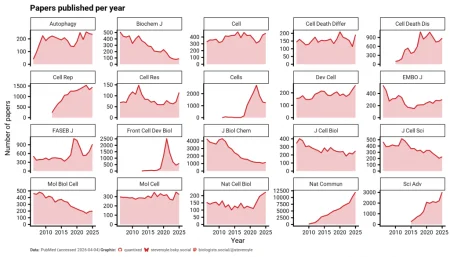
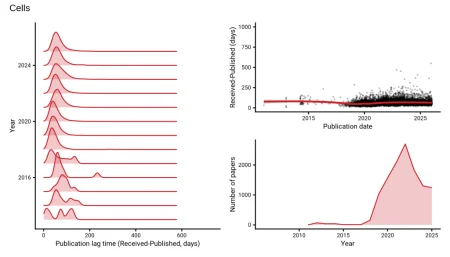
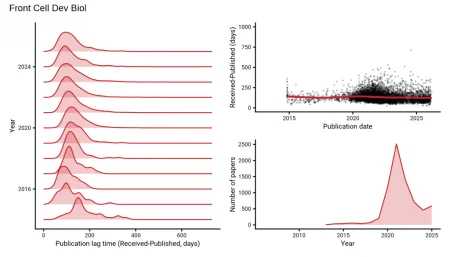
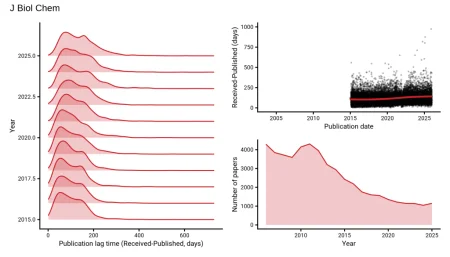
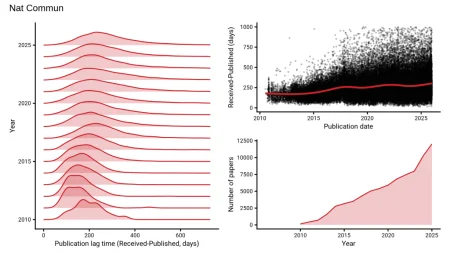
The output volume has shifted dramatically. Powerhouses like Nature Communications have scaled to publishing roughly 12,500 papers annually as of 2025. Conversely, we are seeing a "boom and bust" pattern in journals like Frontiers in Cell and Developmental Biology and Cells—shifts that correlate with well-documented editorial controversies, such as instances of failed peer review. Established titles like J Biol Chem have seen a steady decline, a trend analyzed in depth by published research elsewhere.
The Cost of Delay
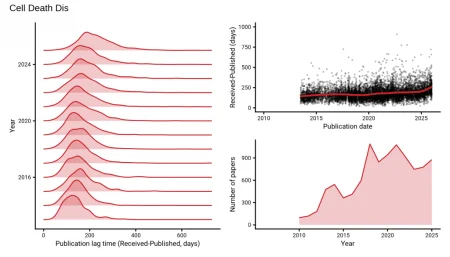
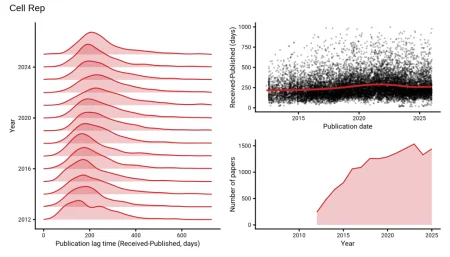
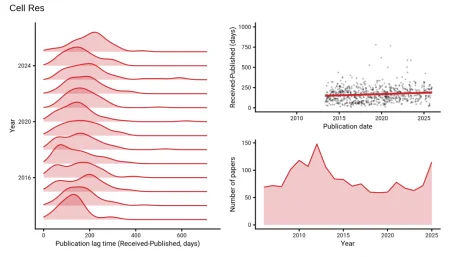
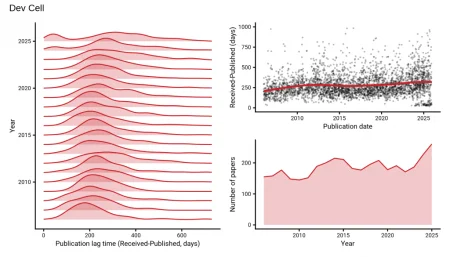
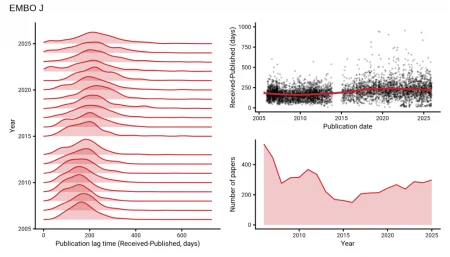
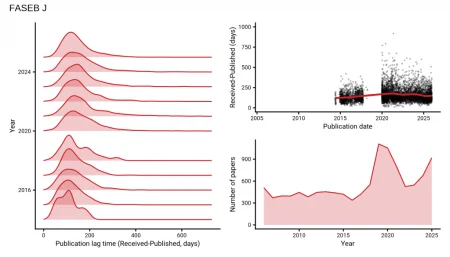
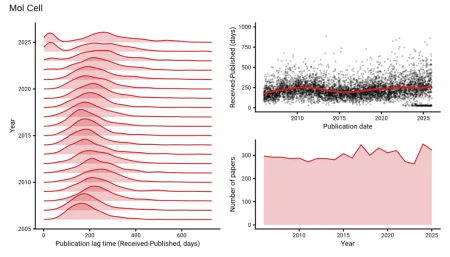
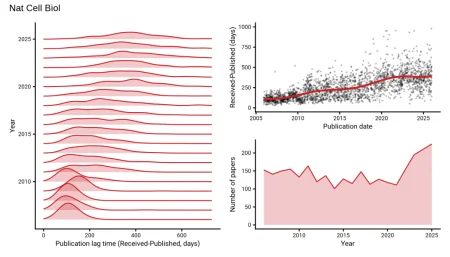
Defining lag as the number of days from "received" to "published," the data reveals that for top-tier outlets like Nature Cell Biology, a year-long wait is now standard. While some journals maintain a tighter 200-day window, the bulk of this time is consumed by the "received-to-accepted" phase rather than production logistics. For a more detailed breakdown of these metrics across 2025, refer to the table below.
| Journal | Year | Accepted-Published | Recieved-Published | Recieved-Accepted |
| Biochem J | 2025 | 6 | 125 | 116 |
| Cell | 2025 | 29 | 308.5 | 275.5 |
| Cell Death Differ | 2025 | 13 | 235 | 221 |
| Cell Death Dis | 2025 | 18 | 218 | 193 |
| Cell Rep | 2025 | 23 | 233 | 209 |
| Cell Res | 2025 | 34 | 208.5 | 172 |
| Cells | 2025 | 16 | 57 | 41 |
| Dev Cell | 2025 | 27 | 322 | 296 |
| EMBO J | 2025 | 27 | 222 | 196 |
| FASEB J | 2025 | 13 | 131 | 117 |
| Front Cell Dev Biol | 2025 | 35 | 111 | 71 |
| J Biol Chem | 2025 | 9 | 128 | 117 |
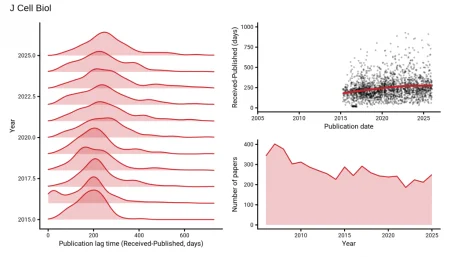
| J Cell Biol | 2025 | 35 | 259 | 218 |
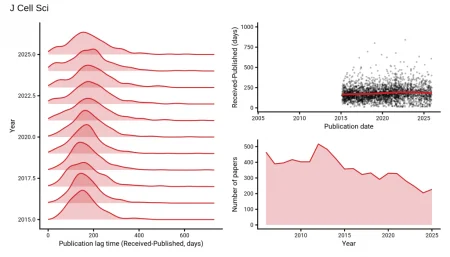
| J Cell Sci | 2025 | 13 | 168.5 | 155 |
| Mol Cell | 2025 | 27 | 258 | 231 |
| Nat Cell Biol | 2025 | 48 | 381.5 | 327 |
| Nat Commun | 2025 | 20 | 266 | 241 |
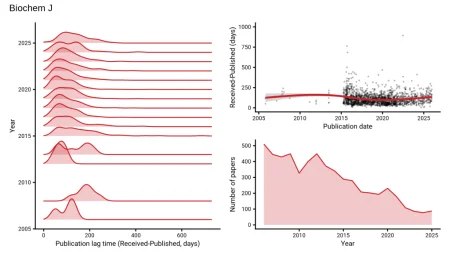
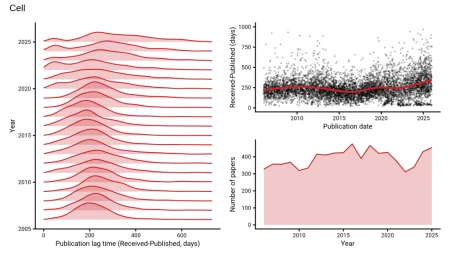
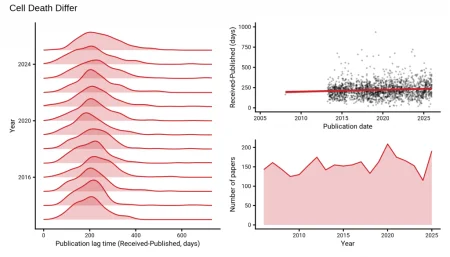
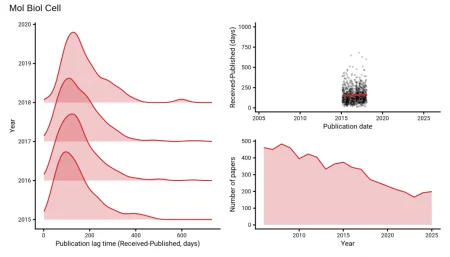
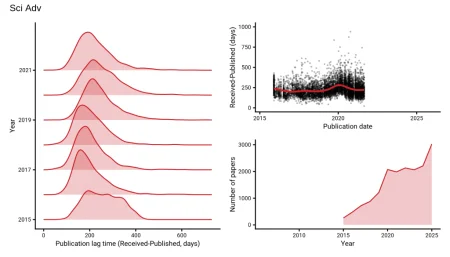
While the median provides a bird's-eye view, the extremes are telling. Scatter plots illustrate that multi-year waits are not historical anomalies; they are current realities for a significant minority of papers. I have capped my visualizations at three years to maintain clarity, though outliers reaching seven years persist. These patterns likely stem from editorial transfer protocols, where papers funneled between journals within the same publishing group appear to have anomalous—or suspiciously rapid—acceptance times.
The provided visual gallery captures a cross-section of publication lag trends across major biology-focused journals, ranging from Biochem J and Cell to Sci Adv. These plots offer a stark, quantitative look at the friction inherent in the peer-review process.
The Long-Haul Outliers
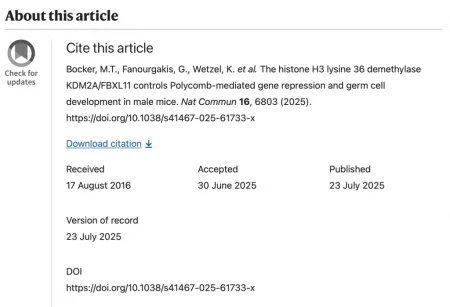
The data reveals a striking trend toward administrative inertia, particularly at Nature Communications. This journal accounts for nine of the ten most extreme outliers regarding publication delays. The most egregious case—a staggering 3,263-day wait—approaches a nine-year cycle from submission to print. While every paper has an origin story, a delay of this magnitude suggests systemic bottlenecks that demand a serious rethink of how scientific discourse is gatekept.
For those curious about the nomenclature, the title of this analysis tips its hat to the Guided by Voices track “Hold On Hope.” If you have questions regarding the methodology or the underlying dataset, the author is collecting feedback over at the original blog post.