Bayesian Distributed Lag Non-Linear Models with {bdlnm}
Environmental stressors—most notably extreme heat and air quality degradation—rarely manifest their physiological consequences in real-time. Mortality spikes often follow days after an initial heatwave, while atmospheric pollutants can trigger cumulative, delayed health impacts. Modeling these delayed, non-linear dependencies requires a specialized framework, typically the Distributed Lag Non-Linear Model (DLNM), which acts as the industry standard for reconciling the exposure-response and lag-response functions that characterize public health data.
The standard DLNM approach utilizes cross-basis functions, usually constructed from splines, to simultaneously resolve the exposure-response and lag-response dimensions. However, as longitudinal datasets expand across more regions and longer time horizons, frequentist estimation methods often struggle with stability and numerical convergence. The newly released bdlnm package addresses this by porting the DLNM architecture into a Bayesian setting, leveraging the Integrated Nested Laplace Approximation (INLA) to sidestep the prohibitive computational bottlenecks that plague Markov Chain Monte Carlo (MCMC) simulations in large-scale epidemiological studies.
By shifting to a Bayesian implementation, researchers gain three primary operational advantages: superior support for complex hierarchical model structures, immediate access to complete posterior distributions for better estimation, and more robust uncertainty quantification. Unlike frequentist methods, which can struggle to produce reliable intervals in sparse or noisy data scenarios, the INLA-backed approach provides a cleaner approximation of the posterior density. You can track ongoing development and contribute to the source code on GitHub.
Deployment and Prerequisites
The package is currently available on CRAN, but users must exercise caution regarding the underlying dependencies. Integration requires a specific and stable build of INLA (version 23.4.24 or later) to function correctly, as the package relies heavily on the specific API hooks within the INLA implementation. Ensure your environment is prepared for cross-platform compatibility before attempting deployment in production pipelines:
# Ensure R environment is updated
install.packages("bdlnm")
library(bdlnm)

# INLA installation requires specific repository targeting
install.packages(
  "INLA",
  repos = c(getOption("repos"), INLA = "https://inla.r-inla-download.org/R/stable"),
  dep = TRUE
)
Methodological Scope
At its core, bdlnm formalizes the relationship between environmental exposure and mortality through a flexible Poisson regression framework. The model log-link function accounts for the intercept ($\alpha$), the cross-basis function ($cb$) capturing the interaction of exposure and lag, and a summation of time-varying covariates ($u_{kt}$) designed to filter out seasonal or long-term trends:
This mathematical implementation effectively separates the risk progression over temperature levels from the temporal lag decay. By decoupling these two dimensions, the analyst gains a granular, interpretable view of how transient external events correlate with long-term population health outcomes, provided the underlying basis functions are specified with appropriate degrees of freedom.
Final Thoughts: Beyond Climate Epidemiology
The bdlnm package represents a significant technical milestone for researchers utilizing Bayesian inference. By merging the structural advantages of Distributed Lag Non-Linear Models (DLNM) with the computational efficiency of Integrated Nested Laplace Approximations (INLA), it provides a framework for disentangling complex exposure-lag-response functions that would otherwise remain opaque. The precision afforded by this Bayesian approach is particularly evident in the mortality analysis of London’s 75+ cohort, where the model attributes roughly 17.5% of deaths—nearly 70,000 cases—to non-optimal temperatures between 2000 and 2012.
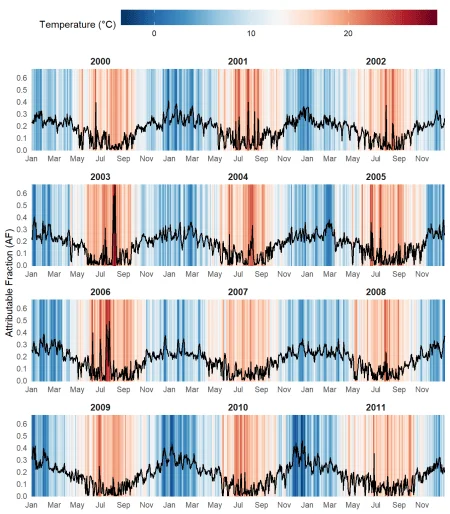
While its current primary focus is environmental epidemiology, the underlying architecture is inherently agnostic and portable. Analysts in finance or supply chain logistics could just as easily leverage this methodology to model the delayed impact of market shocks or infrastructure disruptions on outcome variables, provided they can define the cross-basis constraints for their specific datasets.
Looking ahead, the development roadmap is clear and focused on scalability. The maintainers have signaled a shift toward multi-location pooling and advanced spatial modeling, often referred to as SB-DLNM, which will be critical for scaling these insights across geographically diverse and heterogeneous datasets. For now, the package is available on CRAN, with ongoing development and issue tracking hosted on GitHub.
Core References
- Gasparrini A. (2011). Distributed lag linear and non-linear models in R: the package dlnm.
- Quijal-Zamorano M., et al. (2024). Spatial Bayesian distributed lag non-linear models (SB-DLNM) for small-area exposure-lag-response epidemiological modelling.
- Rue H., et al. (2009). Approximate Bayesian inference for latent Gaussian models by using integrated nested Laplace approximations.
- Gasparrini A., Leone M. (2014). Attributable risk from distributed lag models.