Macroeconomic Reality: Why Your Data Vintages Are Misleading You
Economic indicators—GDP, employment figures, and inflation metrics—are rarely static snapshots. They are fluid, moving targets. In practice, initial releases are often little more than informed guesses, subject to iterative adjustments as statistical agencies integrate newer source data, apply benchmark revisions, and refine seasonal modeling. For the professional analyst, relying on a single "current" release is a hazardous practice. If you are building models based on the assumption that today’s GDP figure is the definitive word on the past, you are likely baking significant bias into your forecasts.
The reviser package, developed by Marc Burri and Philipp Wegmüller, aims to formalize how analysts handle these "vintage" datasets. Recently passing rOpenSci peer review, the package moves beyond the artisanal, ad-hoc methods—plotting revision triangles in custom spreadsheets—that have long characterized the sector.
The Structural Problem: Managing Data Evolution
The core challenge is not just data availability, but data provenance. A single time series may exist in dozens of versions; each "vintage" captures the state of knowledge at a specific publication date. Ignoring this history risks masking the very information that could improve model accuracy. reviser provides a standardized API to bridge the gap between messy, multi-vintage files and clean, analytical workflows.
The package architecture focuses on three primary operational layers:
- Structuring: Converting diverse release formats into a tidy, navigable schema.
- Diagnostic Testing: Quantifying bias, dispersion, and the signal-to-noise ratio inherent in revisions.
- Modeling: Transitioning from retrospective analysis to active nowcasting.
By forcing these steps into a coherent R workflow, reviser enables users to determine, statistically, when a release has reached a "mature" state. It turns the question "How accurate is this estimate?" into a testable hypothesis regarding whether additional revisions contribute meaningful signal or mere statistical noise.
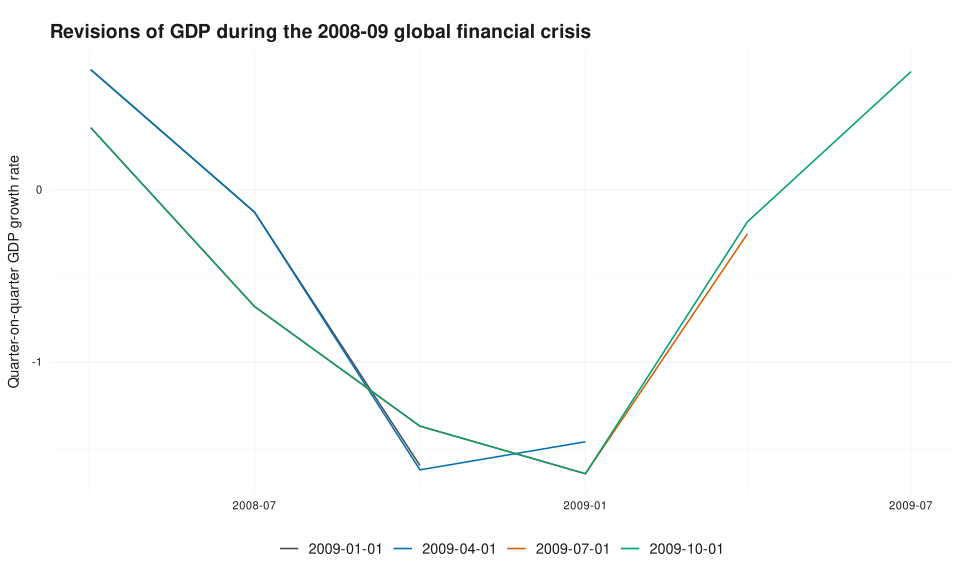
GDP growth vintages for the United States during the 2008-09 global financial crisis.
Moving Beyond Descriptive Diagnostics
Where most tools stop at visualization, reviser offers state-space modeling capabilities for those treating revisions as a latent-data problem. The package includes built-in implementations of the Kishor-Koenig and Jacobs-Van Norden models. By utilizing these frameworks, an analyst can separate the "news"—actual changes in the underlying economic reality—from the "noise"—the administrative adjustments that inevitably follow an initial release.
In the Kishor-Koenig example provided by the package authors, the model successfully identifies the third published release as the point of "efficiency" for Euro Area GDP data. This implies that subsequent revisions are essentially refinements around the signal already captured, rather than fundamental redefinitions of the growth path. For a data-driven strategy, knowing exactly which release to anchor your model on is as valuable as the model itself.
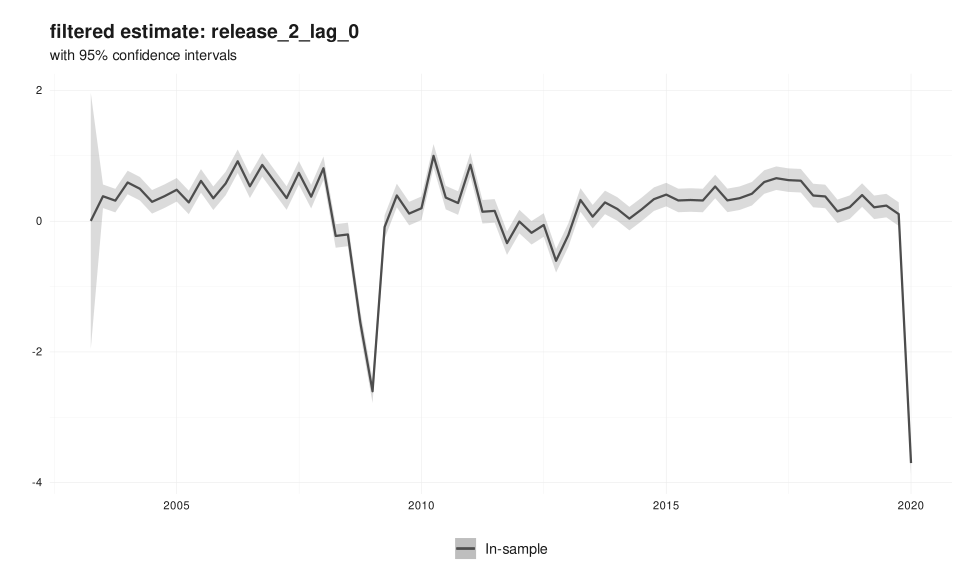
Diagnostic plot from the Kishor-Koenig nowcast example.
Why This Workflow Matters
The professional standard for macro-analysis has historically been fragmented. Teams often maintain bespoke pipelines for each indicator, leading to "model drift" where the logic used to interpret one data stream is fundamentally incompatible with another. reviser is significant because it provides a centralized, reproducible infrastructure. By standardizing the handling of vintage data, it allows analysts to compare, contrast, and test their revision hypotheses across multiple datasets without re-engineering their entire codebase.
The package is currently available via the rOpenSci R-universe:
install.packages(
"reviser",
repos = c("https://ropensci.r-universe.dev", "https://cloud.r-project.org")
)
For those interested in the underlying methodology or contributing to the toolset, the source code is available on GitHub, with documentation and vignettes hosted at https://docs.ropensci.org/reviser.
Strategic Takeaways
The future of macroeconomic modeling lies in the intelligent integration of vintage data. As statistical agencies move toward more high-frequency releases, the volume of noise will likely increase, not decrease. Future-proofing your analytical stack requires moving away from the "latest release" mentality. Start by stress-testing your current models against the reviser workflow; if your results are hypersensitive to the first three releases of a dataset, your model is likely chasing noise. In environments where precision is at a premium, understanding the lifecycle of your data is no longer a peripheral task—it is the foundation of the work.
If you find that your primary datasets do not fit the standard vintage structure, treat that as a primary indicator of complexity. The real value for the industry will come from users who stress-test the package with idiosyncratic, real-world data and push these state-space models to account for non-standard revision triggers. Standardizing how we interpret these changes is the only way to ensure that our conclusions are based on signals, not on the shifting sands of early-stage statistical reporting.