In bioinformatics, structural insights are often locked away in massive, distributed datasets. When I set out to determine the prevalence of transmembrane domains (TMDs) within the human proteome—specifically identifying how many proteins possess single versus multiple membrane-spanning segments—I found that an easily digestible summary simply didn't exist in the public literature. Consequently, I built a custom R workflow to pull this data directly from Uniprot to verify the architecture of these proteins for myself.
The Human Landscape
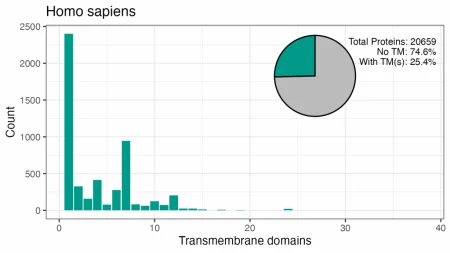
The raw numbers from Uniprot are telling. Out of 20,659 total entries, approximately 25% contain at least one TMD. The distribution is heavily skewed toward single-pass proteins, though we see a significant population of ~1,000 seven-transmembrane (7TM) proteins, likely dominated by the GPCR superfamily. Beyond the common 2TM (327 entries) and 4TM (413 entries) configurations, the spectrum of complexity reaches extreme heights: while counts exist for nearly every number up to 17, outliers persist, including two proteins harboring 38 TMDs.
A note on methodology: This analysis relies on counting TRANSMEM annotations assigned to each ID. I have made no effort to filter for helical versus partial entries, and like any large-scale database query, these results are subject to the inherent limitations of current manual or algorithmic annotations.
| TMD Count | Frequency (%) |
|---|---|
| 1 | 11.6 |
| 7 | 4.6 |
| 4 | 2.0 |
| 2 | 1.6 |
| 6 | 1.3 |
| 12 | 1.0 |
Broadening the Scope
To provide context, I extended this scan to standard model organisms—yeast, worms, fruit flies, and zebrafish.
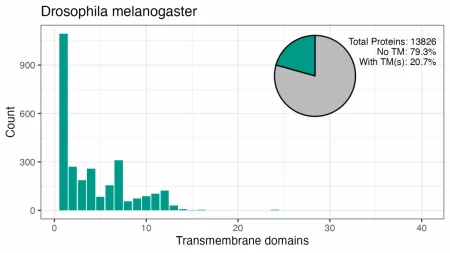
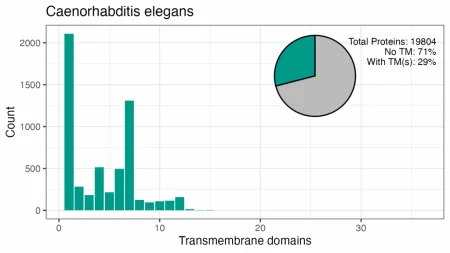
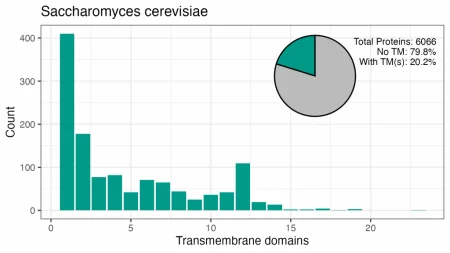
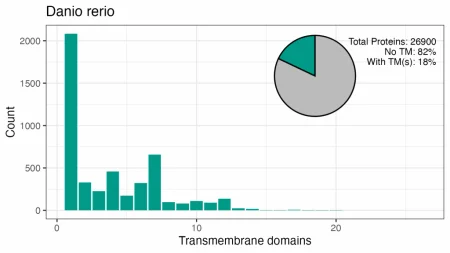
Across these species, TMD-containing proteins consistently represent 18% to 29% of the total proteome. However, the structural signatures diverge significantly; for instance, the characteristic 7TM peak observed in human data is largely absent in yeast, indicating distinct membrane protein evolution across different domains of life.
Replicating the Results
The data was sourced from Uniprot's reference proteomes, processed locally using a standard shell utility to isolate the IDs:
awk '/^>sp\|.*\|/{gsub(/^>sp\|/,""); gsub(/\|.*/,""); print ">" $0; next} {print}' file.fasta | grep "^>" | sed 's/>//g' > species_uniprot.txt
While I initially attempted to streamline the secondary R-based extraction script, the current iteration is the only one that successfully handles the API-specific overhead without crashing. It is provided here as-is for those looking to verify these figures or repeat the analysis for other genomes.
Automating data retrieval from the UniProt REST API requires a robust approach to handling asynchronous jobs. The provided R implementation utilizes a polling mechanism via httr to monitor job status, ensuring that results are captured only after processing is complete. By partitioning requests into chunks and managing redirects, this script effectively bypasses the size limitations inherent in standard paged API responses.
Once the proteomic data is retrieved, the workflow shifts to structural visualization. The script iterates through a defined set of species—spanning from Saccharomyces cerevisiae to Homo sapiens—to generate comparative insights regarding transmembrane domain (TMD) frequency. The synthesis of these metrics relies on cowplot, which allows for the nesting of a summary pie chart within a primary bar graph. This visual layering provides a concise overview of the distribution of membrane-bound proteins versus those lacking TMDs, quantified by total protein count and relative percentage.
For those looking to replicate or expand this analysis, the complete code and methodology are documented on the original post, My Domain: proteome-wide scanning of TMDs. Given the reliance on external databases like UniProt, maintaining high-performance scripts that gracefully handle timeouts and API changes is essential for long-term bioinformatics projects. As biological datasets continue to expand, the ability to programmatically normalize and analyze heterogeneous identifiers remains a fundamental skill in the R ecosystem.
R-bloggers.com offers daily e-mail updates about R news and tutorials about learning R and many other topics. Click here if you're looking to post or find an R/data-science job.
Want to share your content on R-bloggers? click here if you have a blog, or here if you don't.