The latest iteration of browser-based social engineering, dubbed "Pushpaganda" by security researchers, signals a maturity in how malicious actors exploit the personalized recommendation loops built into modern mobile operating systems. By weaponizing the Google Discover feed and Chrome’s native recommendation engine, this campaign bypasses the traditional hurdle of convincing a user to download a malicious APK or binary. Instead, it converts legitimate browser notification permissions into a persistent, high-latency distribution channel for fraud and scareware.
The operational mechanics are deceptively simple. Operators leverage generative AI to churn out high volumes of clickbait content—ranging from government payout schemes to suspiciously affordable consumer electronics—designed to mirror the stylistic norms of legitimate journalism. Because these articles are fed into Google Discover and Chrome tab suggestions, they inherit a veneer of platform-sanctioned credibility. A user, seeing a headline about a local tax refund or a discounted flagship phone, is unlikely to scrutinize the source domain with the same rigor they would apply to a random search result.
Once a user lands on the attacker-controlled landing page, the objective shifts to a single interaction: the "Allow notifications" browser prompt. This is a battle of cognitive load. The pages are engineered to create a false dependency, frequently asserting that the notification toggle is a functional requirement to view the article content or verify the user's eligibility for the promised payout. The design leverages the fact that browser UI patterns have conditioned users to dismiss permission prompts as quickly as possible to regain control of their screen.
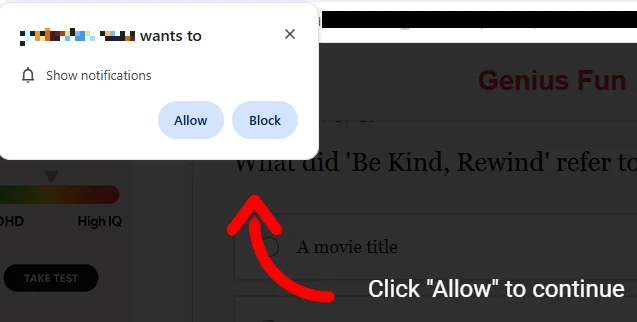
The critical danger here is the persistence of the access gained. Once a user clicks "Allow," the browser establishes a push subscription that is effectively decoupled from the original site. Because these notifications function via native browser APIs, they circumvent conventional ad-blocking lists that target display ads or pop-up overlays. These alerts then manifest in the user’s system tray alongside messages from trusted banking, messaging, or enterprise applications. This proximity to legitimate communications provides the attacker with a high degree of trust-transference, making the follow-up scams appear as standard system alerts.
The downstream consequences for the user are multifaceted. The Pushpaganda network does not merely serve a single static advertisement; it functions as a high-traffic redirect engine. Victims are funneled into a rotation of domains that aggregate data for identity theft, push financial scams, or attempt to monetize the victim through aggressive subscription traps. Even when the user is not actively interacting with the scam, the device may be working in the background, loading tracking scripts or additional malicious assets, thereby depleting system resources and exposing the user to further vulnerability.
The efficacy of this operation highlights a systemic failure in how modern mobile browsers handle permission-based notifications. While browser vendors have introduced friction to limit spam, the inherent utility of push notifications—providing timely updates—is diametrically opposed to the stringent security controls required to prevent abuse by bad actors. When the browser’s interface treats a notification request from a high-quality news site the same as one from a freshly spun-up domain, the weakest link becomes the user’s reflex to bypass UI blockers.
To mitigate the risk of Pushpaganda and similar campaigns, users must adopt a more adversarial stance toward native browser UI prompts. If a prompt appears on a site sourced from a news feed or search result, particularly one that mandates authorization to access information, it should be treated as a zero-trust event. Furthermore, as threat actors increasingly use AI to automate the creation of convincing landing pages, traditional heuristic checks—such as looking for grammatical errors or poor design—are no longer reliable indicators of a site’s integrity.
Beyond individual hygiene, the responsibility shifts toward platform-level intervention. As researchers at Human Security and Malwarebytes have noted, this operation is fundamentally an abuse of the discovery ecosystem. Until search and recommendation algorithms can better identify the provenance of content and the malicious intent behind specific landing pages, the notification tray will remain a primary target for scareware and ad fraud.
For security professionals, this case serves as a reminder that the perimeter has shifted from the network to the browser’s API layer. Monitoring for unusual browser notification activity is as critical as tracking inbound phishing attempts. As we look ahead, the industry should expect this model of "discovery-first" social engineering to scale as AI generation costs continue to trend toward zero. Defending against it will require a combination of stricter browser-level policy enforcement and a fundamental pivot in how users perceive persistent browser notifications—not as a standard utility, but as a high-risk vector for compromise.
For further information on mobile threat mitigation, see the security resources for iOS and Android environments.