The AI App Paradox: Why Productivity Tools are Driving a Storefront Surge
For the past eighteen months, the prevailing narrative across Silicon Valley has been one of platform obsolescence. High-profile figures, including Nothing CEO Carl Pei, have championed the idea that the smartphone app era is approaching its terminal phase, soon to be eclipsed by AI agents and ambient computing hardware like the rumored device currently under development by OpenAI and Jony Ive. Yet, the empirical data from the first quarter of 2026 suggests a diametrically opposite trend: we are in the midst of a massive, AI-fueled expansion of the mobile application ecosystem.
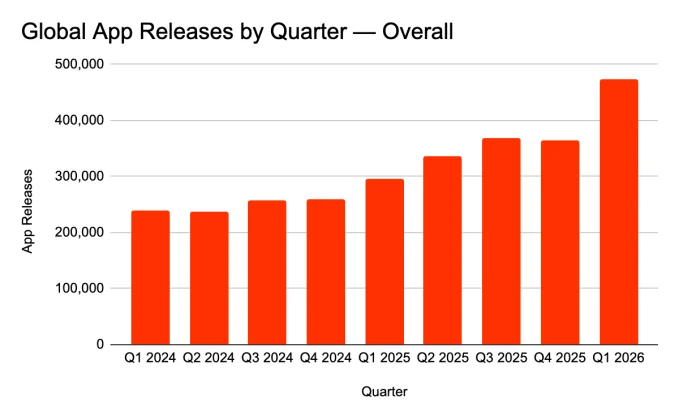
According to analysis from market intelligence firm Appfigures, worldwide app releases surged 60% year-over-year in Q1 2026. The velocity is accelerating as the year progresses; by April, the total volume of new releases across Apple’s App Store and Google Play increased by 104% compared to the same period in 2025. On the iOS side specifically, that growth represents an 89% increase. Apple’s Senior Vice President of Worldwide Marketing, Greg “Joz” Joswiak, recently noted that reports of the App Store's demise appear to have been “greatly exaggerated,” a sentiment now backed by a quantifiable renaissance in software development.
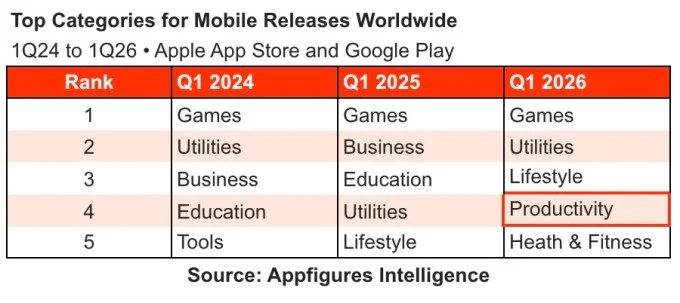
The primary catalyst for this influx appears to be the democratization of development. Tools such as Replit and Claude Code are likely lowering the technical barrier to entry, enabling a new class of "vibe coders"—creators with conceptual intent but minimal traditional engineering background. This shift is clearly reflected in the shifting composition of the App Store. While mobile gaming maintains its traditional volume lead, Q1 2026 data shows productivity, utilities, and lifestyle applications climbing the ranks, with each category moving into the top five most-released segments.
However, this rapid influx of AI-generated or AI-assisted software is placing an unsustainable strain on existing curation and moderation models. The sheer volume of incoming code is testing the limits of App Store vetting, leading to high-profile failures that the platform can ill afford. Just this week, Apple was forced to remove the rewards app Freecash—which had sat comfortably in the Top Charts for months—due to policy violations. More concerning is the recent breach involving a clone of the Ledger Live cryptocurrency wallet, which successfully navigated the approval process only to facilitate the theft of $9.5 million in assets.
Historically, Apple has relied on automated systems and standard review processes to handle the bulk of submissions. In 2024 alone, the company reported rejecting over 320,000 spammy or copycat apps and blocking 37,000 fraudulent submissions, while also removing 17,000 apps for bait-and-switch tactics. But the current surge in volume, combined with the sophistication of AI-assisted bad actors, is exposing the structural inadequacy of these defenses. Veteran observers, such as John Gruber, have intensified calls for a dedicated “bunco squad”—a specialized task force designed specifically to hunt for and proactively neutralize high-grossing, fraudulent software before it reaches critical mass in the charts.
Meet your next investor or portfolio startup at Disrupt
Your next round. Your next hire. Your next breakout opportunity. Find it at TechCrunch Disrupt 2026, where 10,000+ founders, investors, and tech leaders gather for three days of 250+ tactical sessions, powerful introductions, and market-defining innovation. Register now to save up to $410.
The core tension is clear: AI is effectively killing the barrier to software creation, which is fueling a volume boom the likes of which the App Store has never seen. However, if platforms cannot solve the signal-to-noise and security problems inherent in this AI-driven expansion, the resulting "app gold rush" may quickly devolve into a "scam gold rush." Moving forward, success for Apple and Google won't be measured by the raw count of apps released, but by their ability to refine, curate, and sanitize a marketplace that is now orders of magnitude noisier than it was even a year ago.